Welcome to DreamsPlus

PMP®

How We Rewrote the Way PMP® Exam Preparation Feels

A story-first, journey-mapped approach to the 2026 PMP® exam — where every one of the 26 ECO tasks is learned through a living project, not a passive list of theory. “Most PMP® prep courses teach you what project management is. We decided to teach you what it feels like — so that when you walk into the exam room, every scenario question feels like a page from a project you have already lived.” — Dreamsp​lus Institute, Chennai The Problem We Set Out to Solve The PMP® exam does not test memory. It tests judgement. The 2026 PMP® exam is 180 questions, 240 minutes, and approximately 60% agile and hybrid scenarios. It does not ask you to define a product backlog. It places you in the middle of Sprint 4, with a compliance alert on your screen, a vendor missing their SLA, and two stakeholders whose expectations are drifting apart — and it asks: what do you do next? That kind of question cannot be answered by memorising the Examination Content Outline. It can only be answered by someone who has internalised how projects feel at their most pressured moments — who has, in some sense, been there. That was the problem we chose to solve. And the answer we built is unlike anything currently available in the PMP® preparation space in India — or, as far as we know, anywhere.  The Methodology Teaching through a living project, not a list of tasks. We began with the ECO — the Examination Content Outline that PMI uses as the authoritative blueprint for every PMP® exam question. It defines three domains, 26 tasks, and hundreds of enablers. Most training programmes teach these as a structured syllabus: Domain I has 8 tasks, Domain II has 10, Domain III has 8. Study each one. Tick it off. We asked a different question: what if every one of those 26 tasks, and every one of those enablers, was taught as a moment inside a real project? Not illustrated by an example — but actually embedded in a story, with a specific timestamp, a named person, a real pressure, and a real consequence? The result is what we call the Journey Map Method — three interactive digital maps, one for each ECO domain, all set inside a single project: the development of an AI-powered food booking application, from Day 1 kick-off to Launch Day plus 14.  Domain I · 33% of Exam People Journey Map Vision, leadership, conflict, stakeholders, communication — all 8 tasks lived across 5 project stages. Domain II · 41% of Exam Process Journey Map Plan, deliver, scope, quality, risk, schedule, procurement, finance, closure — all 10 tasks in action. Domain III · 26% of Exam Business Environment Map Governance, compliance, change control, risk, continuous improvement, external environment — all 8 tasks embedded in the project story. 📍 A moment from the Process Domain Journey Map — Stage 3: Execution “Sprint 4, Tuesday 8:47am. The payment gateway sandbox is returning 503 errors. Integration testing is blocked. I log the P1 impediment at 8:47am. You are contacted by 10am. The gateway is restored by 2:00pm. Total resolution time: 5 hours 13 minutes. Within target. Logged. Vendor performance tracker updated. Escalation path confirmed as working.” This is not a case study read aloud from a slide. This is the student’s own story — because in the journey map, the student is the Project Coordinator. They joined on Day 1. They built the conflict risk log in Week 1. They drafted the compliance matrix before Sprint 1. They managed the vendor miss in Sprint 4. They ran the knowledge extraction session when the key developer went on leave. By the time they sit the PMP® exam and read a scenario question set in the execution phase of a hybrid project with a compliance alert active — they have already been there. The exam feels familiar, not foreign. Why It Works The science behind story-first learning for experienced professionals. PMP® candidates are not beginners. They arrive with 36 months or more of project management experience. Traditional instruction — content delivery, flashcards, practice questions — often fails them not because they lack intelligence, but because their existing experience creates a barrier: they compare every concept to what they already know, and where the theory feels abstract, it does not anchor. Story-based learning works for experienced professionals precisely because it gives theory a home inside experience. When a candidate reads about T3.4 — Remove Impediments and Manage Issues — as a bullet point, it may or may not connect to something they remember from a past project. When they have just spent an hour managing a P1 impediment in the AI Food App, logging it at 8:47am and resolving it by 2pm, it connects immediately and permanently.  Contextual Retrieval Concepts learned inside a story are recalled faster under exam pressure. The scenario in the exam triggers the memory of the journey map moment. Cross-Domain Integration The journey maps show all three domains operating simultaneously — because real projects do not pause Domain II while Domain III is happening. Agile & Hybrid Native The AI Food App is a hybrid project by design — 60% of the exam is agile/hybrid. Students learn the approach from inside the project, not as a separate theory module. 2026 Exam Aligned Sustainability, AI governance, and DPDPA compliance are embedded in the project story — exactly where the July 2026 exam places them. “We did not add story to our PMP® programme. We built the programme around the story — and let the ECO tasks emerge naturally from the project they were always part of.” The Structure Five project stages. Twenty-six ECO tasks. One unified story. The journey maps follow the natural arc of the AI Food Booking App project across five stages — and in each stage, every domain task is shown in the context of what the project is doing at that moment. Nothing is taught in isolation. The student experiences the project as a PM would actually live it.  Stage

DevOps

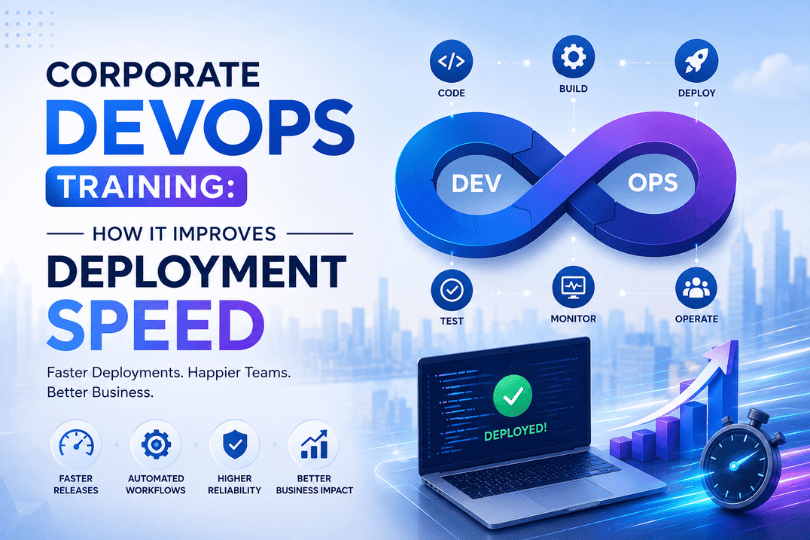
Corporate DevOps Training: How It Improves Deployment Speed

Introduction Slow deployments cost more than time. Every delayed release means slower feedback, longerbug-fix cycles, and a widening gap between what the business needs and what engineering can ship.For many organizations, the bottleneck isn’t tooling — it’s that teams haven’t been trained to useDevOps practices consistently. That’s where structured corporate DevOps training makes ameasurable difference. Why Deployment Speed Stalls Most companies already own the tools — CI/CD pipelines, containerization platforms, monitoring dashboards. But tools alone don’t fix slow releases. Common blockers include: Manual handoffs between development, QA, and operations Inconsistent branching and release practices across teams Fear of deployment failure leading to infrequent, high-risk releases Lack of shared ownership between developers and operations staff These are process and culture problems, not tooling problems — and process problems are solved through training, not procurement. How DevOps Training Closes the Gap A well-structured corporate DevOps program addresses the actual causes of deployment delay:  Standardized CI/CD practices Teams learn to build and maintain pipelines that automatically test, build, and deploy code, removing manual steps that introduce delay and error Infrastructure as Code (IaC Training in tools like Terraform or Ansible lets teams provision environments consistently, cutting down environment-related deployment failures. Monitoring and feedback loops Employees learn to set up real-time monitoring so issues are caught immediately after deployment, not days later. Collaborative culture DevOps training breaks down the “dev vs. ops” divide, teaching cross-functional teams to share responsibility for releases. Incremental deployment strategies Techniques like blue-green deployments and canary releases let teams ship smaller changes more frequently, reducing risk per release. The Business Impact Organizations that invest in structured DevOps training typically see: Shorter release cycles, from weeks to days or hours Fewer failed deployments and faster rollback when issues occur Reduced dependency on a small group of “tribal knowledge” engineers Better alignment between engineering output and business timelines What Effective Corporate Training Looks Like Generic online courses rarely translate into real workplace change. Effective corporate DevOpstraining should:  Be tailored to the organization’s existing tech stack and workflows Include hands-on labs, not just theory Involve both developers and operations/infrastructure staff Be delivered in a format that fits working schedules (weekend batches, evening sessions, or on-site workshops) Conclusion Deployment speed isn’t just an engineering metric — it’s a competitive advantage. Teams that release faster, with fewer failures, respond to market and customer needs quicker than their competitors. Corporate DevOps training turns scattered tool usage into a disciplined, repeatable process — and that discipline is what actually moves deployment speed. 

Artificial Intelligence

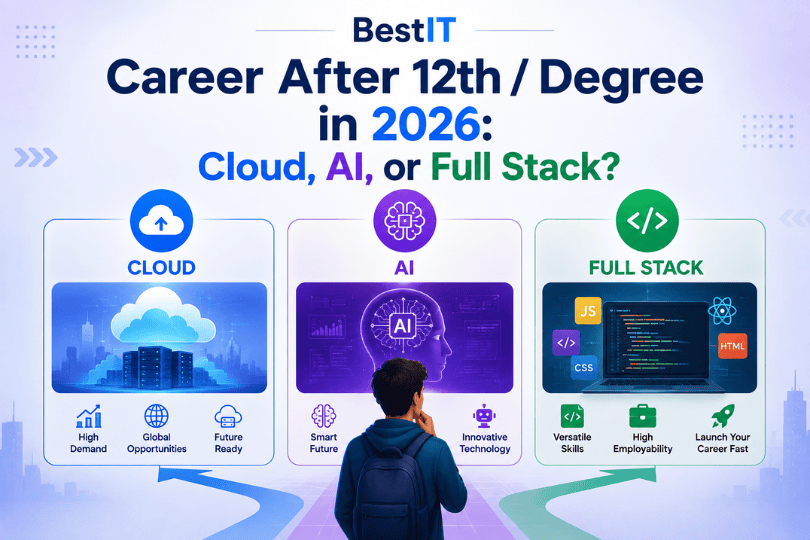
Best IT Career After 12th / Degree in 2026: Cloud, AI, or Full Stack?

Introduction If you’re finishing school or college in 2026 and trying to figure out which IT path actually leads to a job, you’re not alone. Cloud computing, Artificial Intelligence, and Full Stack Development are the three careers students ask us about the most at DreamsPlus — and each one has a very different day-to-day, learning curve, and salary ceiling. This guide breaks down all three honestly, so you can pick based on fit, not hype. Why This Decision Matters More in 2026 The IT hiring market has shifted. Companies aren’t just hiring “IT graduates” anymore — they’re hiring people who can prove a specific, in-demand skill on day one. That means your first certification or course choice shapes your first job title, your starting salary, and how fast you get interview calls. The good news: you don’t need a four-year head start. Focused, practical training (3-6 months) in any of these three tracks can get a fresher job-ready. 01 Cloud Computing (AWS / Azure / Google Cloud) What the job actually looks like Cloud engineers manage the infrastructure that apps run on — servers, storage, networking, security — mostly through cloud platforms like AWS, Microsoft Azure, or Google Cloud, rather than physical hardware. Why it’s hot right now Almost every company, from startups to banks, has moved or is moving to the cloud. That creates ongoing demand for people who can set up, secure, and manage that infrastructure — and it’s not a trend that reverses. Good fit if you Like systems, infrastructure, and “how things work under the hood” Enjoy troubleshooting and problem-solving over visual design Want a role with strong job security and steady demand across industries Typical entry point AWS Certified Solutions Architect – Associate or Microsoft Azure AdministratorAssociate. Both are respected, vendor-recognized certifications that recruiters specifically search for. Career ceiling Cloud Architect, DevOps Engineer, Site Reliability Engineer (SRE) — roles that are both high-paying and hard to automate away. 02 Artificial Intelligence (AI/ML) What the job actually looks like AI roles range from building and training machine learning models to working with generative AI tools, AI agents, and automation pipelines that businesses are now racing to adopt. Why it’s hot right now 2026 is seeing a sharp shift from companies experimenting with AI to companies actually deploying it — which means demand is moving from “AI researchers” to “AI implementers” who can build practical, working solutions. Good fit if you Enjoy math, logic, and experimentation Are comfortable with a steeper learning curve early on Want to work on the most talked-about technology in the industry right now Typical entry point A foundation program that combines Python, core ML concepts, and hands-on AI tool use — followed by a specialization like AI Engineering orAgentic AI development once you’ve found your footing Career ceiling AI Engineer, Machine Learning Engineer, AI Product roles — among the highest-paid IT careers today, but also the most competitive to break into. 03 Full Stack Web Development What the job actually looks like Full stack developers build both the front end (what users see and click) and the back end (databases, servers, business logic) of websites and applications. Why it’s hot right now Every company needs a website or app, which makes full stack development the most universally hireable IT skill — it’s not tied to one industry or one type of company Good fit if you Like seeing immediate, visual results from your work Want the fastest realistic path from “no experience” to “job-ready portfolio” Prefer building complete products over managing infrastructure Typical entry point A structured Full Stack Development program covering front-end frameworks, back-end languages, and databases, capped with 2-3 real projects for your portfolio. Career ceiling Senior Full Stack Developer, Software Architect, Technical Lead — and it’s often the easiest of the three to transition into freelancing or product-building. Quick Comparison Factor Cloud AI Full Stack Learning curve Moderate Steep Moderate Time to first job-ready skill 2-4 months 4-6 months 3-5 months Competition for entry roles Medium High Medium Long-term demand Very high Very high High Best for Systems thinkers Math/logic-minded Builders who like visible output So Which One Should You Choose? There’s no universally “best” option — there’s a best option for you. A few honest rules of thumb: If you want the safest, steadiest bet: Cloud computing has broad, consistent demand across every industry and company size. If you want the highest ceiling and don’t mind a harder climb: AI is where the most exciting (and highest-paying) work is heading, but expect more competition for entry-level roles. If you want to start building and earning fastest: Full Stack Development has the shortest path from zero to a portfolio you can show employers. You can also combine paths later — many Cloud engineers pick up DevOps, and many Full Stack developers add AI integration skills once they’re working. Your first course doesn’t have to be your last. Start With the Right Foundation At DreamsPlus, we’ve trained IT professionals in Chennai for over 18 years across Cloud (AWS, Azure, Google Cloud), AI, Full Stack Development, and more — with hands-on projects, expert mentors, and placement support built into every program. If you’re still unsure which path fits you, our team offers free counseling to help you map your background and goals to the right course. Get in touch to talk it through.

AWS Cloud

AWS vs Azure vs Google Cloud: Which Certification Should You Choose in Chennai?

Introduction Cloud computing skills are now a baseline expectation across IT roles in Chennai, not just a specialization. But with three major cloud platforms — AWS, Microsoft Azure, and Google Cloud Platform (GCP) — choosing which certification to pursue first can feel confusing. The right choice depends on your current role, target companies, and career direction, not just which platform is “most popular.” Why This Decision Matters Certifications aren’t just resume additions — they signal depth of hands-on skill to employers. Chennai’s IT job market has strong demand across all three platforms, but the concentration of opportunities varies by industry and company type. Picking the certification aligned with your target employers saves time and gives you a faster return on your training investment.  AWS Certification: The Market Leader AWS remains the most widely adopted cloud platform globally and in Chennai’s IT and product companies. It’s often the default starting point for professionals with no strong platform preference yet. Best for: Developers, sysadmins, and DevOps engineers targeting product-based companies, startups, and IT service providers with AWS-heavy infrastructure. Popular certifications: AWS Certified Solutions Architect – Associate, AWS Certified Developer – Associate, AWS Certified DevOps Engineer – Professional. Chennai relevance: A large share of IT services companies and captive centers in Chennai run AWS-based client projects, making this a safe first choice for most learners. Microsoft Azure: Strong in Enterprise and MNC Environments Azure has deep penetration in enterprise IT, especially in organizations already using Microsoft’s ecosystem (Windows Server, Active Directory, Office 365, Dynamics).  Best for: Professionals working in or targeting large enterprises, BFSI (banking, financial services, insurance), and MNCs with existing Microsoft infrastructure. Popular certifications: Microsoft Certified: Azure Administrator Associate, Azure Solutions Architect Expert, Azure DevOps Engineer Expert. Chennai relevance: Several Chennai-based captive units of global enterprises and BFSI-focused IT companies run Azure-centric environments, making this a strong choice if you’re targeting that sector. Google Cloud Platform: Growing, Data and AI-Focused GCP has a smaller overall market share compared to AWS and Azure but is strong in data engineering, machine learning, and analytics-heavy roles.  Best for: Professionals interested in data engineering, machine learning, or working withcompanies that prioritize GCP’s data and AI tooling (BigQuery, Vertex AI). Popular certifications: Google Cloud Associate Cloud Engineer, Professional Data Engineer, Professional Machine Learning Engineer. Chennai relevance: Fewer companies run GCP as their primary cloud compared to AWS/Azure,but it’s a strong differentiator for data and AI-focused roles, particularly in product companies andanalytics teams. How to Decide: A Quick Framework New to cloud, no clear target company? Start with AWS — the broadest applicability and most job listings. Targeting enterprise, BFSI, or Microsoft-stack companies? Choose Azure. Interested in data engineering, analytics, or ML roles? Choose GCP. Already working with a specific platform at your job? Certify in that platform first — it reinforces what you already use daily and is easiest to justify to your employer. A Note on Stacking Certifications Many professionals in Chennai eventually pursue certifications across two platforms — commonly AWS + Azure — since job postings often list “AWS or Azure” as acceptable. Starting with one and adding a second within 6–12 months is a practical path once you have real project experience to back it up.   Conclusion There’s no universally “best” cloud certification — only the one best aligned with your career directionand the employers you’re targeting in Chennai’s IT market. If you’re unsure, AWS is the safeststarting point for broad applicability, with Azure and GCP as strong follow-ups depending on thedirection your career takes.

Agile Developers

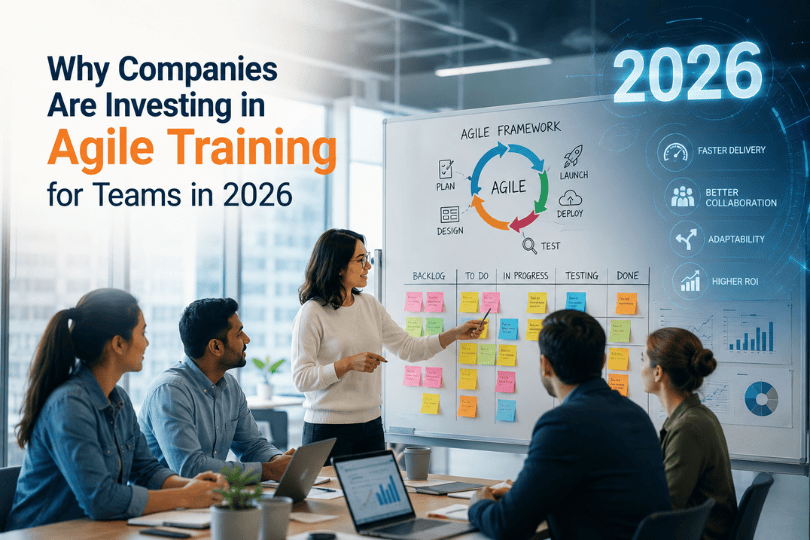
Why Companies Are Investing in Agile Training for Teams in 2026

Introduction Agile isn’t new — most organizations adopted some version of it years ago. But in 2026, companies are going back to basics and re-investing in structured Agile training, not because the framework changed, but because the gap between “doing Agile” and “being Agile” has become too costly to ignore. The Problem: Agile in Name, Not in Practice Many teams run daily stand-ups, sprints, and retrospectives without actually gaining the benefits Agile promises — faster delivery, better collaboration, and adaptability to change. This happens when teams learn Agile ceremonies informally, on the job, without understanding the principles behind them. The result is what’s often called “cargo cult Agile” — the rituals without the mindset. Companies have started recognizing this gap directly affects delivery speed, team morale, and product quality. That recognition is driving a fresh wave of investment in formal Agile training. Why 2026 Specifically A few converging factors are pushing this now: Post-restructuring team rebuilding Many companies went through layoffs, restructuring, or hybrid-work transitions over the past few years. New and reshuffled teams need shared Agile fluency to work effectively together again. AI-assisted development changing team dynamics As AI tools speed up coding and reduce manual development work, the bottleneck has shifted to planning, prioritization, and cross-functional collaboration—all core Agile skills. Pressure for faster time-to-market Competitive markets are pushing companies to ship faster without sacrificing quality, which depends heavily on how well teams execute Agile practices, not just whether they use them. Scaling Agile across larger, distributed teams As teams span multiple locations and time zones, informally learned Agile practices break down. Structured training standardizes how teams collaborate regardless of location. What Companies Are Actually Training For Agile training in 2026 covers more than the basics of Scrum or Kanban. Common focus areas include: Role clarity – Ensuring Scrum Masters, Product Owners, and team members understand their accountabilities, not just their job titles. Backlog management and prioritization – Training teams to make deliberate trade-offs instead of treating the backlog as a dumping ground. Effective retrospectives – Moving beyond “what went well/what didn’t” checklists to retrospectives that produce real process improvements. Scaling frameworks – For larger organizations, training in SAFe, LeSS, or Scrum@Scale to coordinate multiple teams without losing Agile’s core benefits. Agile for non-software teams – Marketing, HR, and operations teams adopting Agile principles for their own workflows, a growing trend beyond traditional software development. The Business Case For leadership, the investment case is straightforward: Reduced rework through better sprint planning and improved backlog clarity. Faster identification and resolution of blockers through structured Agile ceremonies. Improved team morale with clearer role definitions and more effective retrospectives. Better cross-team coordination as organizations scale Agile practices consistently. What Makes Training Effective Not all Agile training delivers results. Programs that actually change team behavior typically: Involve entire teams together, not just individual employees, since Agile is a team practice rather than an individual skill. Include real work scenarios and role-play activities instead of focusing only on theoretical framework explanations. Follow up with ongoing coaching or regular check-ins, since a single workshop rarely changes deeply ingrained habits. Tailor the training to the team’s actual maturity level instead of using a one-size-fits-all curriculum. Conclusion Companies aren’t investing in Agile training in 2026 because Agile is new — they’re investing because the cost of doing it poorly has become clear. As delivery speed, distributed teams, and AI-driven workflows raise the stakes, structured training is what turns Agile from a set of rituals into an actual competitive advantage.