
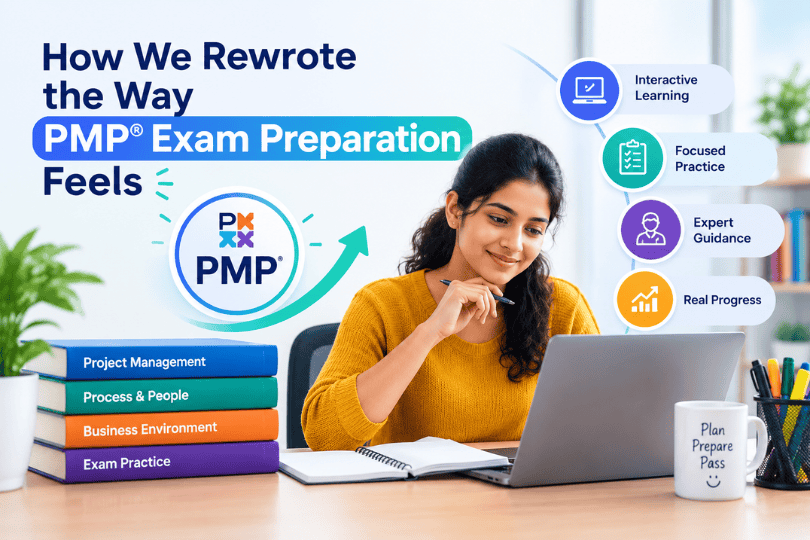
A story-first, journey-mapped approach to the 2026 PMP® exam — where every one of the 26 ECO tasks is learned through a living project, not a passive list of theory.
"Most PMP® prep courses teach you what project management is. We decided to teach you what it feels like — so that when you walk into the exam room, every scenario question feels like a page from a project you have already lived."
— Dreamsplus Institute, Chennai
The PMP® exam does not test memory. It tests judgement.
The 2026 PMP® exam is 180 questions, 240 minutes, and approximately 60% agile and hybrid scenarios. It does not ask you to define a product backlog. It places you in the middle of Sprint 4, with a compliance alert on your screen, a vendor missing their SLA, and two stakeholders whose expectations are drifting apart — and it asks: what do you do next?
That kind of question cannot be answered by memorising the Examination Content Outline. It can only be answered by someone who has internalised how projects feel at their most pressured moments — who has, in some sense, been there.
That was the problem we chose to solve. And the answer we built is unlike anything currently available in the PMP® preparation space in India — or, as far as we know, anywhere.
Teaching through a living project, not a list of tasks.
We began with the ECO — the Examination Content Outline that PMI uses as the authoritative blueprint for every PMP® exam question. It defines three domains, 26 tasks, and hundreds of enablers. Most training programmes teach these as a structured syllabus: Domain I has 8 tasks, Domain II has 10, Domain III has 8. Study each one. Tick it off.
We asked a different question: what if every one of those 26 tasks, and every one of those enablers, was taught as a moment inside a real project? Not illustrated by an example — but actually embedded in a story, with a specific timestamp, a named person, a real pressure, and a real consequence?
The result is what we call the Journey Map Method — three interactive digital maps, one for each ECO domain, all set inside a single project: the development of an AI-powered food booking application, from Day 1 kick-off to Launch Day plus 14.

Domain I · 33% of Exam
People Journey Map
Vision, leadership, conflict, stakeholders, communication — all 8 tasks lived across 5 project stages.
Domain II · 41% of Exam
Process Journey Map
Plan, deliver, scope, quality, risk, schedule, procurement, finance, closure — all 10 tasks in action.
Domain III · 26% of Exam
Business Environment Map
Governance, compliance, change control, risk, continuous improvement, external environment — all 8 tasks embedded in the project story.“Sprint 4, Tuesday 8:47am. The payment gateway sandbox is returning 503 errors. Integration testing is blocked. I log the P1 impediment at 8:47am. You are contacted by 10am. The gateway is restored by 2:00pm. Total resolution time: 5 hours 13 minutes. Within target. Logged. Vendor performance tracker updated. Escalation path confirmed as working.”
This is not a case study read aloud from a slide. This is the student’s own story — because in the journey map, the student is the Project Coordinator. They joined on Day 1. They built the conflict risk log in Week 1. They drafted the compliance matrix before Sprint 1. They managed the vendor miss in Sprint 4. They ran the knowledge extraction session when the key developer went on leave.
By the time they sit the PMP® exam and read a scenario question set in the execution phase of a hybrid project with a compliance alert active — they have already been there. The exam feels familiar, not foreign.
The science behind story-first learning for experienced professionals.
PMP® candidates are not beginners. They arrive with 36 months or more of project management experience. Traditional instruction — content delivery, flashcards, practice questions — often fails them not because they lack intelligence, but because their existing experience creates a barrier: they compare every concept to what they already know, and where the theory feels abstract, it does not anchor.
Story-based learning works for experienced professionals precisely because it gives theory a home inside experience. When a candidate reads about T3.4 — Remove Impediments and Manage Issues — as a bullet point, it may or may not connect to something they remember from a past project. When they have just spent an hour managing a P1 impediment in the AI Food App, logging it at 8:47am and resolving it by 2pm, it connects immediately and permanently.

Contextual Retrieval
Concepts learned inside a story are recalled faster under exam pressure. The scenario in the exam triggers the memory of the journey map moment.
Cross-Domain Integration
The journey maps show all three domains operating simultaneously — because real projects do not pause Domain II while Domain III is happening.
Agile & Hybrid Native
The AI Food App is a hybrid project by design — 60% of the exam is agile/hybrid. Students learn the approach from inside the project, not as a separate theory module.
2026 Exam Aligned
Sustainability, AI governance, and DPDPA compliance are embedded in the project story — exactly where the July 2026 exam places them.
“We did not add story to our PMP® programme. We built the programme around the story — and let the ECO tasks emerge naturally from the project they were always part of.”
Five project stages. Twenty-six ECO tasks. One unified story.
The journey maps follow the natural arc of the AI Food Booking App project across five stages — and in each stage, every domain task is shown in the context of what the project is doing at that moment. Nothing is taught in isolation. The student experiences the project as a PM would actually live it.
Stage 1 — Initiation: Governance structures established. Compliance register built. Conflict risk log created. Scope workshop facilitated. Resource conflicts flagged on Day 3. Risk register live with 24 identified risks before Sprint 1 begins.
Stage 2 — Detailed Planning: All subsidiary plans integrated and cross-checked. Scope baseline signed. Budget baselined at ₹46L with 15% contingency. Sprint 1 planned in full. Phase gate green — execution authorised.
Stage 3 — Execution: Seven sprints. Real tensions. A vendor SLA missed. A DPDPA compliance alert at 8:47am. An ops lead satisfaction score dropping. A developer going on leave mid-critical-path. All managed, documented, learned from.
Stage 4 — Monitoring and Controlling: AI model accuracy below target. Schedule amber. Budget variance identified and escalated. Recovery package approved by steering. Stakeholder re-engagement managed transparently. Governance working faster under pressure than in calm.
Stage 5 — Closure: 94% scope delivered. 28 lessons captured. All OPAs updated. Knowledge handed over. Restaurant partners at 94% readiness. Ops team at 91%. Project formally closed with every stakeholder’s signature on the acceptance document.
26
Eco Tasks
Covered
3
Interactive
Maps
5
Project
Stages
18+
Years of
Teaching
1,736
Google
Reviews
The project scenario was chosen with the exam in mind.
The 2026 PMP® exam explicitly adds Artificial Intelligence as a theme for the first time. Candidates will encounter questions about AI governance, AI risk management, AI in project planning, and the compliance implications of AI-generated outputs. Most training programmes acknowledge this in a slide. We built it into the project.
The AI Food Booking App has an AI recommendation engine at its core. Managing the model’s accuracy — it starts at 71%, needs to reach 85%, faces a retraining crisis when it drops below the trigger threshold — is not a sidebar in our teaching. It is the central technical risk of the project, and it drives decisions across all three ECO domains simultaneously: Domain I (stakeholder communication about the accuracy miss), Domain II (schedule and budget impact of retraining), Domain III (governance escalation and the risk-to-issue reclassification when probability crosses 0.63).
The project also embeds DPDPA compliance (India’s data protection law), PCI-DSS payment security, FSSAI food safety requirements, and sustainability criteria — all threaded naturally through the story, not listed as separate modules. This is exactly how the 2026 exam presents compliance and sustainability: not as separate theory, but as active conditions of a running project.
What this means for every DreamsPlus PMP® student
When you attend a DreamsPlus PMP® preparation workshop, you do not sit through a presentation of the ECO. You join a project in progress. You take the role of a Project Coordinator who has just joined an experienced PM’s team. You manage the conflict in Week 1. You flag the resource risk on Day 3. You draft the compliance matrix before Sprint 1. You handle the DPDPA alert at 8:47am in Sprint 4. You write the closure report on Launch Day plus 14.
And when you walk into the PMP® exam room — whether in Chennai or anywhere else in the world — and you read a scenario question about a hybrid project facing a compliance risk in execution, it does not feel like a question about theory. It feels like a question about something that happened to you. Because, in the most meaningful sense of the word, it did.
That is what the DreamsPlus Journey Map Method is. That is why we built it. And that is why we believe every PMP® candidate — regardless of where they study — deserves to learn this way.
Ready to experience it for yourself?
Join our next PMP® 2026 Workshop in Chennai — online, offline, or hybrid. Explore the journey maps. Live the project. Pass the exam.DreamsPlus Institute
Leading IT & Project Management Training · Chennai · dreamsplus.in
Legal Disclaimer, Trademark & Copyright Notice
PMP® (Project Management Professional), PMI®, PMBOK®, and the PMI® Registered Education Provider logo are registered marks and trademarks of the Project Management Institute, Inc. (PMI®), 14 Campus Blvd, Newtown Square, PA 19073-3299, USA · www.pmi.org. All rights — including trademark rights, copyright, and intellectual property rights — in the PMP® certification, the PMBOK® Guide, and the Examination Content Outline (ECO) are owned exclusively by PMI®. Copyright © Project Management Institute, Inc. All rights reserved.
DreamsPlus Institute (DreamsPlus Consulting Pvt. Ltd.) is not affiliated with, endorsed by, accredited by, or an Authorised Training Partner (ATP) of PMI®. The use of PMP®, PMI®, and PMBOK® names and marks in this article is solely for identification and descriptive reference purposes, in accordance with fair use principles, and does not imply any association with or sponsorship by PMI®.
DreamsPlus Institute offers an independent Project Management Workshop designed to build the knowledge, skills, and situational judgement required by practising project managers. Our programme is independently developed, curriculum-aligned with the PMP® Examination Content Outline (ECO), and structured to support candidates preparing for the PMP® examination. Attendance at our workshop does not guarantee examination success; results depend on individual preparation, experience, and effort.
Candidates wishing to sit the PMP® examination must apply directly through PMI® at pmi.org, meet PMI®’s eligibility requirements, and pay PMI®’s examination fee independently. All certification decisions rest solely with PMI®. This article and the materials described herein are the independent intellectual property of DreamsPlus Institute (DreamsPlus Consulting Pvt. Ltd.) and are published for educational and informational purposes only.