

Welcome to DreamsPlus

Introduction

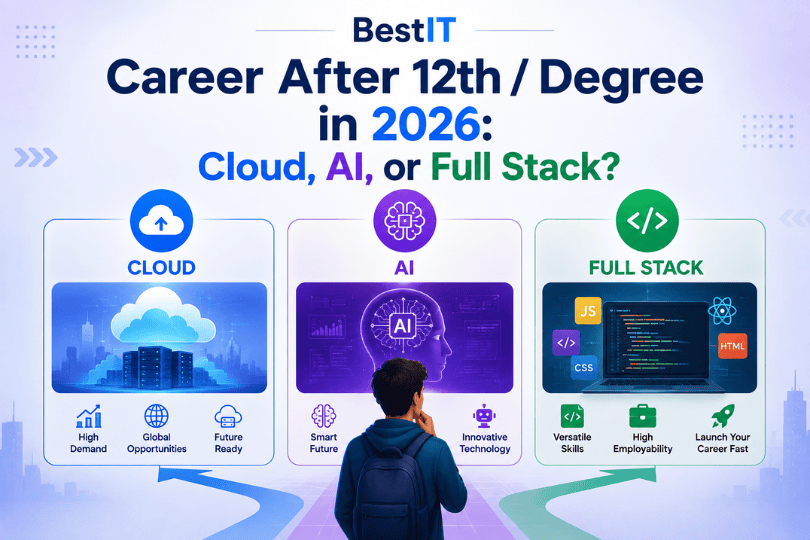
If you’re finishing school or college in 2026 and trying to figure out which IT path actually leads to a job, you’re not alone. Cloud computing, Artificial Intelligence, and Full Stack Development are the three careers students ask us about the most at DreamsPlus — and each one has a very different day-to-day, learning curve, and salary ceiling.

This guide breaks down all three honestly, so you can pick based on fit, not hype.

Why This Decision Matters More in 2026

The IT hiring market has shifted. Companies aren’t just hiring “IT graduates” anymore — they’re hiring people who can prove a specific, in-demand skill on day one. That means your first certification or course choice shapes your first job title, your starting salary, and how fast you get interview calls.

The good news: you don’t need a four-year head start. Focused, practical training (3-6 months) in any of these three tracks can get a fresher job-ready.

01

Cloud Computing (AWS / Azure / Google Cloud)

What the job actually looks like

Cloud engineers manage the infrastructure that apps run on — servers, storage, networking, security — mostly through cloud platforms like AWS, Microsoft Azure, or Google Cloud, rather than physical hardware.

Why it's hot right now

Almost every company, from startups to banks, has moved or is moving to the cloud. That creates ongoing demand for people who can set up, secure, and manage that infrastructure — and it's not a trend that reverses.

Good fit if you

  • Like systems, infrastructure, and “how things work under the hood”
  • Enjoy troubleshooting and problem-solving over visual design
  • Want a role with strong job security and steady demand across industries

Typical entry point

AWS Certified Solutions Architect – Associate or Microsoft Azure AdministratorAssociate. Both are respected, vendor-recognized certifications that recruiters specifically search for.

Career ceiling

Cloud Architect, DevOps Engineer, Site Reliability Engineer (SRE) — roles that are both high-paying and hard to automate away.

02

Artificial Intelligence (AI/ML)

What the job actually looks like

AI roles range from building and training machine learning models to working with generative AI tools, AI agents, and automation pipelines that businesses are now racing to adopt.

Why it's hot right now

2026 is seeing a sharp shift from companies experimenting with AI to companies actually deploying it — which means demand is moving from "AI researchers" to "AI implementers" who can build practical, working solutions.

Good fit if you

  • Enjoy math, logic, and experimentation
  • Are comfortable with a steeper learning curve early on
  • Want to work on the most talked-about technology in the industry right now

Typical entry point

A foundation program that combines Python, core ML concepts, and hands-on AI tool use — followed by a specialization like AI Engineering orAgentic AI development once you've found your footing

Career ceiling

AI Engineer, Machine Learning Engineer, AI Product roles — among the highest-paid IT careers today, but also the most competitive to break into.

03

Full Stack Web Development

What the job actually looks like

Full stack developers build both the front end (what users see and click) and the back end (databases, servers, business logic) of websites and applications.

Why it's hot right now

Every company needs a website or app, which makes full stack development the most universally hireable IT skill — it's not tied to one industry or one type of company

Good fit if you

  • Like seeing immediate, visual results from your work
  • Want the fastest realistic path from “no experience” to “job-ready portfolio”
  • Prefer building complete products over managing infrastructure

Typical entry point

A structured Full Stack Development program covering front-end frameworks, back-end languages, and databases, capped with 2-3 real projects for your portfolio.

Career ceiling

Senior Full Stack Developer, Software Architect, Technical Lead — and it's often the easiest of the three to transition into freelancing or product-building.

Quick Comparison

Factor Cloud AI Full Stack
Learning curve Moderate Steep Moderate
Time to first job-ready skill 2-4 months 4-6 months 3-5 months
Competition for entry roles Medium High Medium
Long-term demand Very high Very high High
Best for Systems thinkers Math/logic-minded Builders who like visible output

So Which One Should You Choose?

There’s no universally “best” option — there’s a best option for you. A few honest rules of
thumb:

  • If you want the safest, steadiest bet: Cloud computing has broad, consistent demand across every industry and company size.
  • If you want the highest ceiling and don’t mind a harder climb: AI is where the most exciting (and highest-paying) work is heading, but expect more competition for entry-level roles.
  • If you want to start building and earning fastest: Full Stack Development has the shortest path from zero to a portfolio you can show employers.

You can also combine paths later — many Cloud engineers pick up DevOps, and many Full
Stack developers add AI integration skills once they’re working. Your first course doesn’t
have to be your last.  

Start With the Right Foundation

At DreamsPlus, we’ve trained IT professionals in Chennai for over 18 years across Cloud (AWS, Azure, Google Cloud), AI, Full Stack Development, and more — with hands-on projects, expert mentors, and placement support built into every program.

If you’re still unsure which path fits you, our team offers free counseling to help you map your background and goals to the right course. Get in touch to talk it through. 

Leave a Reply

Your email address will not be published. Required fields are marked *